AI Prediction of Acoustic Transmission Loss
AcouVApp IsolX AI estimates the airborne sound insulation spectrum of a multilayer sandwich. The tool is designed for quick exploration of assemblies made of solid leaves, air cavities, absorbing layers, and structural links such as studs or point connections.
The result is a predicted transmission loss curve in one-third-octave bands from 100 Hz to 5000 Hz. The page also calculates single-number indicators and lets you paste your own measured or reference spectrum to compare it directly with the AI prediction.
How the Prediction Model Works
The model is trained on a large dataset of more than 500 multilayer sandwich configurations and their corresponding transmission loss spectra measured in laboratory. We use a neural network architecture with different input branches to process the layer properties, the structural links, and the frequency information. The model learns to predict the transmission loss based on the physical characteristics of the layers and their interactions.
The neural network predicts the transmission loss band by band. This frequency-based approach helps the model understand how the same multilayer system behaves differently at low, mid, and high frequencies.
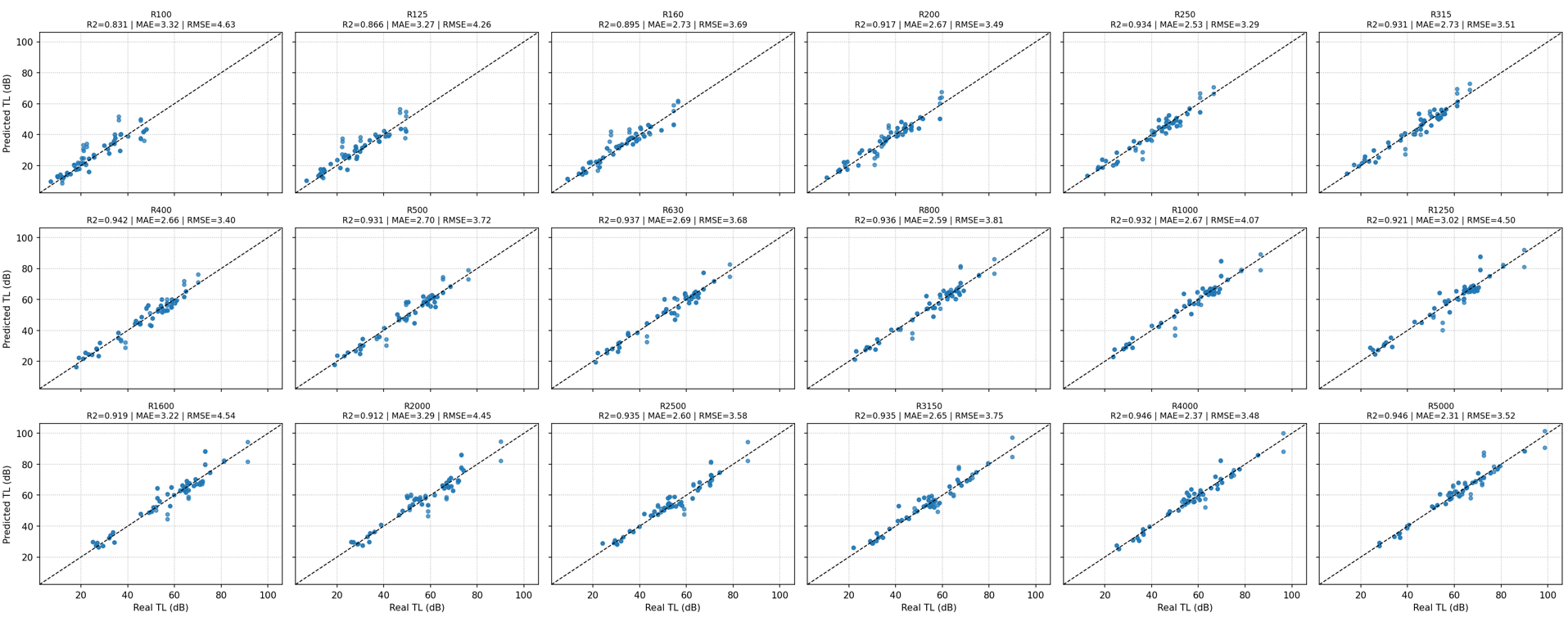
After the training, a validation of the model is done on some data (not used during the training) with a high correlation factor (more than 0.9) that confirm the model works well.
How to Use the Tool
- Add the layers of the sandwich from one side to the other.
- Choose the layer type: solid, air, absorbing, closed, or hollow.
- Use database materials for solid, closed, or hollow layers, or enter the properties manually.
- For absorbing layers, adjust Young modulus, density, damping, and thickness if needed.
- Add structural links when a cavity separates two solid layers.
- Run the calculation and compare the predicted spectrum with your own data in the spectrum table.
Important Modeling Notes
The model is trained to provide fast engineering estimates. It does not replace laboratory measurements, validated finite-element simulations, or expert review for critical design decisions. The prediction quality depends on the training domain, the entered material properties, and how close the tested assembly is to examples already represented in the dataset.
When using this beta version, compare the predicted spectrum with known systems, measured data, or reference calculations. Your feedback is valuable for improving the model and extending its range of reliable applications.
You can test also our calculator based on analytic formula, you can test our tool IsolX.
Need Help or Want to Share Data?
If you identify a questionable prediction or want to compare the tool with your own test data, contact us at lauret@impulsion-acoustique.fr.